
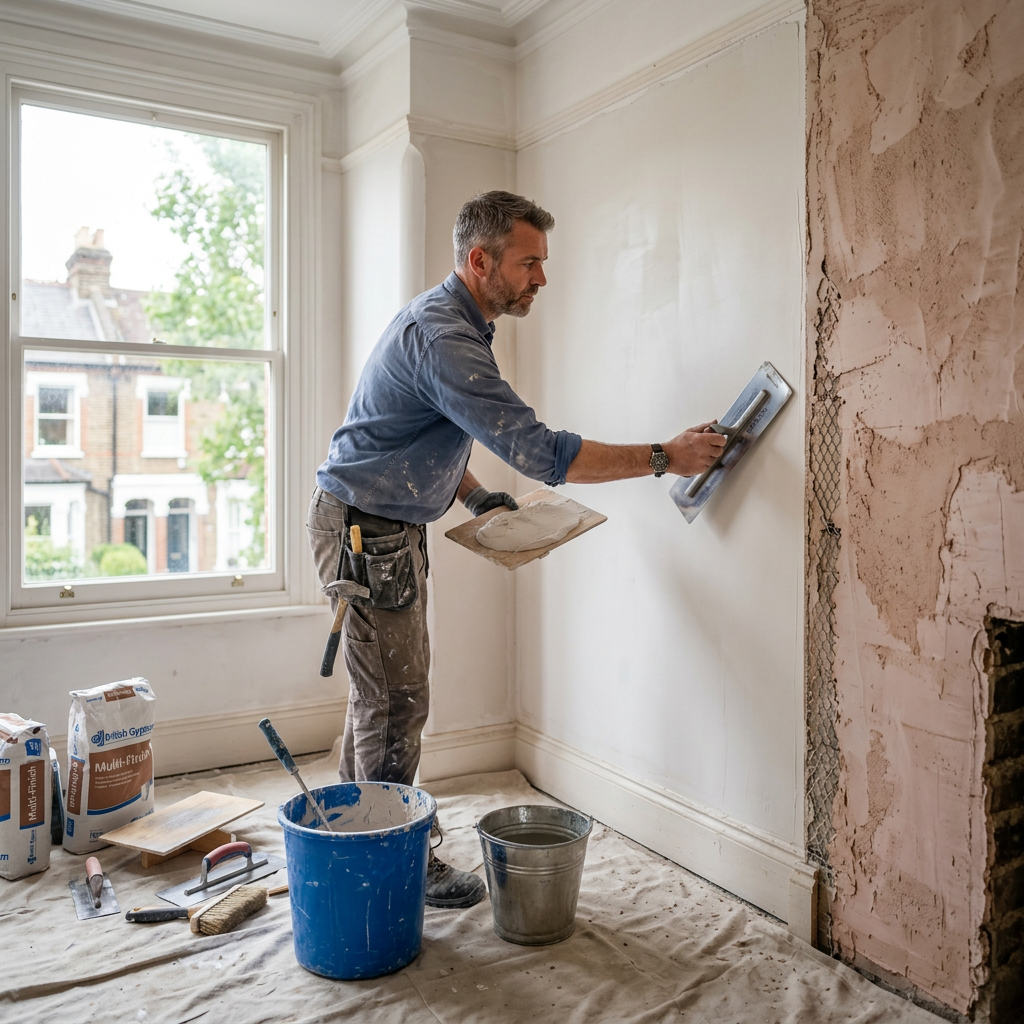
Plasterer vs Drywall Contractor: Key Differences UK
When you're staring at tired walls or planning a renovation, one question catches a lot of London homeowners off guard: do you need a plasterer or a drywall contractor? The two trades overlap in ways that make them easy to confuse, but hire the wrong one and you'll either end up with a finish that doesn't match your building or a bill for work that didn't need doing.
This guide cuts through the confusion — covering what each trade actually does, where the differences lie, and how to decide which one is right for your specific project.
What Does a Plasterer Do?
A plasterer is a skilled tradesperson who applies plaster to walls and ceilings to achieve a smooth, paint-ready surface. In the UK, plastering covers a broad range of work and materials, and an experienced plasterer will typically switch between them depending on the building and the brief.
Types of Plaster Used in the UK
- Lime plaster — the traditional material used in older properties. It's breathable, flexible, and essential for period buildings where moisture management matters. You'll find it behind the walls of Victorian and Edwardian terraces across London.
- Gypsum plaster (Thistle) — the most common interior plastering material today. Fast-drying and gives an excellent smooth finish on new plasterboard or over existing walls.
- Cement plaster — a harder, more durable mix typically used for external surfaces or areas exposed to damp.
What a Plasterer Will Handle
- Skimming — applying a 2–3mm finish coat of plaster over existing walls or new plasterboard to create a flat, smooth surface ready for decorating. See our guide to what skimming is for more detail.
- Full re-plastering — stripping back to the substrate and applying multiple coats, often required in older properties or where walls have failed.
- Patch repairs — filling cracks, holes, and damaged sections to blend seamlessly with surrounding plaster. Our plaster crack repair service covers this in detail.
- Ceiling work — from patching water-damaged areas to full ceiling replacement, including lath and plaster ceiling repairs.
- Decorative plasterwork — coving, cornices, and mouldings, particularly common in period properties across Kensington, Islington, and Greenwich.
- Lime plastering — specialist work for conservation properties where modern materials aren't appropriate. We cover this in our lime plastering London guide.
A good example of the breadth of plastering work is our lath and plaster ceiling replacement and wall re-skim project in Richmond upon Thames, TW9. The original lath and plaster ceiling was stripped entirely back to the bare joists, new plasterboard was fixed, and all four walls were re-skimmed flat — completed across two days. The client noted: "The team stripped the old lath and plaster ceiling completely and had new plasterboard up and skimmed the same day. By day two the walls were done too — all four of them re-skimmed flat."


What Does a Drywall Contractor Do?
A drywall contractor — sometimes called a dryliner — specialises in fixing plasterboard (also called drywall or gypsum board) to create wall structures, partition walls, and ceilings. The focus is on the boarding element: getting panels cut, fixed, and jointed to form the substrate, rather than applying a wet plaster finish on top.
Key Tasks of a Drywall Contractor
- Hanging drywall sheets — cutting and fixing plasterboard panels to timber or metal stud frames to create new walls or partition structures.
- Dot and dab — bonding plasterboard directly to masonry walls using plasterboard adhesive. This is a common approach in new builds and refurbishments across London. Our dot and dab walls London page explains when this method is appropriate.
- Taping and jointing — filling and taping the seams between boards with joint compound (mud) to create a smooth, seamless finish. This is an alternative finishing method to skimming. See our taping and jointing London service for more.
- Soundproofing and insulation installation — many drywall contractors also handle acoustic and thermal insulation as part of a partition or ceiling build-up.
- Ceiling systems — installing suspended ceiling grids and plasterboard ceiling panels.
The Core Differences: Plasterer vs Drywall Contractor
| | Plasterer | Drywall Contractor | |---|---|---| | Primary material | Wet plaster (lime, gypsum, cement) | Plasterboard panels (gypsum board) | | Core skill | Trowel application, hand finishing | Panel fixing, cutting, jointing | | Finish method | Wet skim coat — very smooth | Taped and jointed seams or skim over board | | Ideal for | Renovations, period properties, decorative work | New builds, structural partitions, large boarding runs | | Works on | Existing walls, ceilings, external surfaces | New wall structures, partition systems |
The key distinction is wet versus dry. A plasterer works with wet plaster applied by hand — requiring genuine skill with a trowel to achieve a flat, defect-free finish. A drywall contractor works with sheet materials, using mechanical fixings, adhesive, and jointing compound. In practice, many plastering companies — including London Plastering Service — cover both, because a typical renovation often involves boarding a surface first and then skimming over it.
Our full house re-skim and ceiling replacement project in Redbridge, IG1 is a good illustration. The original lath and plaster ceilings had either been removed or collapsed, so the work involved both trades elements: boarding the ceilings with new plasterboard, then skimming the entire house — walls and ceilings — to a flat finish. "I was expecting the patch on the wall where it had all fallen away to be obvious but you genuinely cannot see where the repair is," the client said.


When to Hire a Plasterer
Choose a plasterer when:
- You're renovating an older London property — Victorian, Edwardian, or inter-war homes require a plasterer who understands traditional materials and techniques. Slapping plasterboard over failed lime plaster without addressing the underlying issue will cause problems within a few years.
- Your walls need skimming — if the surface is structurally sound but uneven, marked, or has had old wallpaper stripped, a skim coat is the right solution. Our wall plastering cost London and skimming cost London pages give current London pricing.
- You need decorative plasterwork — coving, cornices, and ceiling roses require a plasterer with specialist skills. Our plaster coving London page covers what's involved.
- You have a damaged or collapsed ceiling — whether it's a Victorian lath and plaster ceiling or a modern one damaged by a leak, this is plasterer territory. See our ceiling plastering cost London guide.
- You're working with lime — conservation areas, listed buildings, and older properties often require lime-compatible materials. Our lime plastering London service covers this.
When to Hire a Drywall Contractor
Choose a drywall contractor when:
- You're building from scratch — new partition walls in a commercial fit-out or a new extension are typically drylining jobs.
- Speed is the priority — drywall installation is faster than traditional wet plastering. For large-scale new builds, a dry approach is more efficient.
- You need a taping and jointing finish — in some commercial contexts, a taped and jointed finish without a skim coat is acceptable. For residential work in London, most homeowners prefer a skimmed finish over the boarded surface.
- You're adding soundproofing or insulation — a drywall specialist is best placed to design and build the correct partition build-up.
What About Plasterboarding and Skimming?
For most London domestic projects, the answer isn't strictly one trade or the other — it's both, often carried out by the same person or team. A typical bedroom or living room renovation might involve:
- Dot and dabbing new plasterboard to masonry walls
- Boarding a stud partition or ceiling
- Skimming the entire surface to a smooth finish
This is exactly what happened on our media wall plasterboarding and skim project in Greenwich, SE10, where 12.5mm tapered-edge plasterboard was fixed to all faces of a bespoke timber stud media wall frame — including the flat front face, top surfaces, and alcove returns — before being skimmed to a sharp, paint-ready finish. The client's decorator described it as "perfect to paint straight onto."
Our skimming new plasterboard service page explains the process in full, and our plasterboard cost London page covers material and labour pricing.

Costs: What to Expect in London
Pricing varies depending on the extent of the work, access, and the condition of existing surfaces. As a general guide for London:
- Skimming a room — typically priced per day or per m². Our plastering day rates London page gives current figures.
- Full house re-skim — depends on the number of rooms and condition of walls. See our cost to plaster a house guide.
- Ceiling replacement — includes stripping, boarding, and skimming. Covered in our ceiling plastering cost London page.
- Plasterboard supply and fix — our plasterboard cost London guide covers material grades and fixing methods.
You can also get a rough figure using our plastering cost calculator London.
How London Plastering Service Can Help
At London Plastering Service, our plasterers cover the full scope — wet plastering, plasterboard installation, skimming over new board, lime work, and decorative finishes — across all 32 London boroughs. Whether you need a single room skimmed in Ealing or a full lath and plaster ceiling replaced in Richmond, we'll give you a straight assessment of what's actually needed and a clear, honest quote.
Get in touch via our London plasterer page or explore our reviews to see what clients across London say about our work.
Frequently Asked Questions
Is a plasterer the same as a drywall contractor in the UK?
Not exactly. A plasterer applies wet plaster to surfaces using a trowel — a highly skilled process requiring experience to achieve a flat, smooth finish. A drywall contractor focuses on fixing plasterboard panels, taping seams, and jointing. In UK domestic work, the two often overlap because boarding and skimming typically go hand in hand, and many plasterers carry out both elements.
Do I need a plasterer or a drywall contractor for a home renovation in London?
For most London residential renovations — especially in older properties — you'll need a plasterer, or a company that handles both boarding and skimming. Pure drywall contracting without a skim finish is more common in commercial settings. If you're unsure, contact us and we'll advise on what your specific project requires.
What's the difference between skimming and taping and jointing?
Skimming involves applying a thin wet plaster coat over the entire surface to achieve a perfectly smooth finish. Taping and jointing involves filling and taping the seams between plasterboard sheets with a jointing compound, without a full skim coat on top. Skimming gives a superior finish for residential decorating; taping and jointing is faster and more common in commercial work.
Can a plasterer install plasterboard?
Yes — most experienced plasterers, including our team at London Plastering Service, carry out both plasterboarding and skimming as part of the same job. It's actually more efficient to have one team handle both stages rather than separate trades.
Is lime plastering different from standard plastering?
Yes. Lime plaster behaves very differently from modern gypsum-based materials — it's more flexible, breathable, and requires specific application techniques and drying conditions. It's essential for older London properties, particularly in conservation areas or listed buildings where breathability is critical. Our lime plastering London page explains when and why it's needed.
Related Plastering Guides & Services
Need Professional Plastering?
Get expert plastering services in London. Free quotes within 60 minutes.