
Why Does Plaster Turn Pink? A London Plasterer’s Guide
Understanding the Pink Hue: Why Plaster Changes Colour
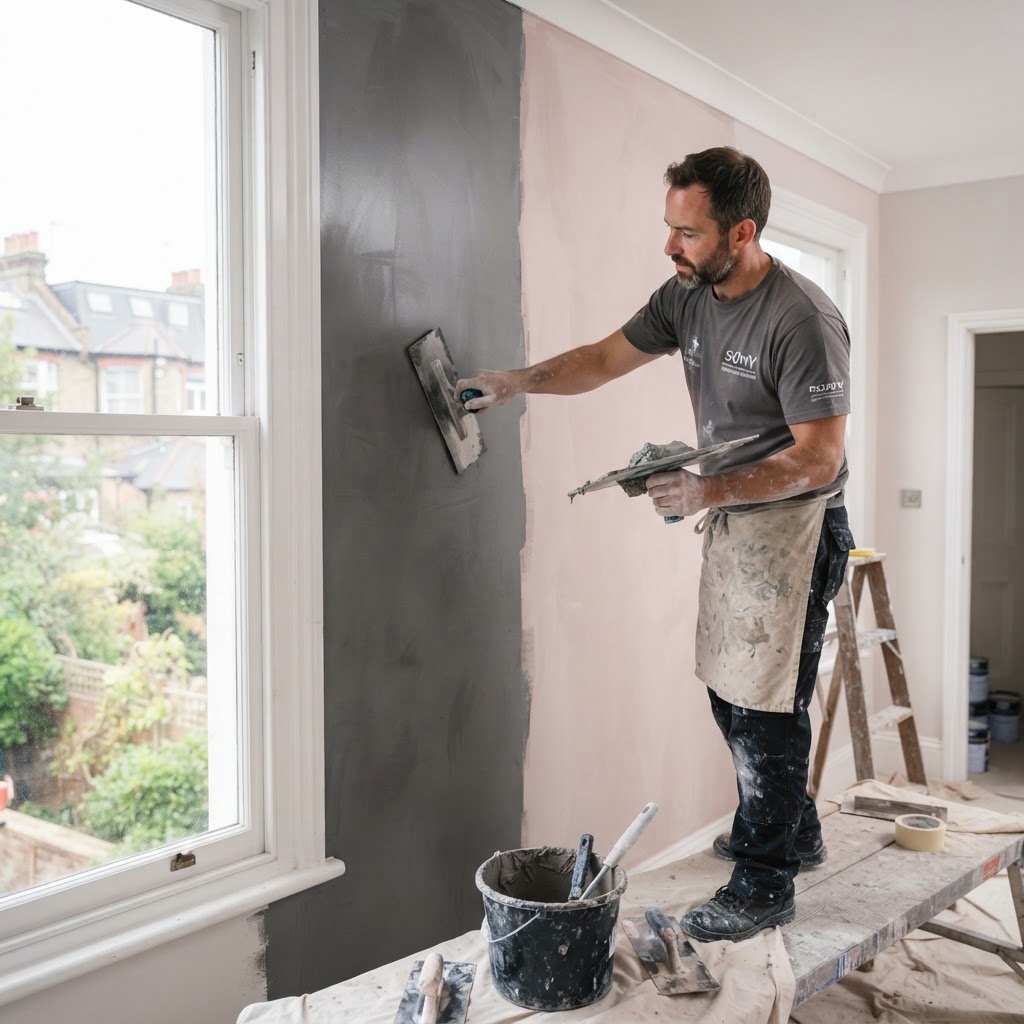
When you hire a professional plasterer London to refresh your home, you might be alarmed to walk into a room after a few hours and notice your perfectly smooth white walls taking on a distinct pink, patchy shade. At London Plastering Service, we receive calls every week from homeowners in boroughs like Wandsworth, Kensington, and Islington, worrying that their new finish is flawed. The short answer? Don't panic. The pink colour is a natural part of the chemical transition of gypsum plaster—a phenomenon known as the 'hydration to dehydration' cycle.
The Science Behind the Drying Process: A Deep Dive
Plaster is essentially a mixture of gypsum (calcium sulphate hemihydrate) and water. When it is applied wet, it is dark and greyish because the water fills the microscopic pores of the material, refracting light differently. As it begins to dry and chemically set, the water evaporates from the surface, and the material starts to turn a lighter, often pinkish-buff colour. This transition indicates that the plaster is moving from its plastic, malleable state to a hard, crystalline solid.
In London, the high humidity often found in older Victorian properties in boroughs like Hackney or Southwark can affect this chemistry. The pink hue is actually a diagnostic tool for a professional; it tells us that the gypsum crystals are correctly interlinking. If you see a consistent pink shade, you can be assured the chemical set is occurring as it should, without premature evaporation or 'burning' of the plaster.
Why Patchy Drying Occurs in London Homes
It is rarely uniform, and this is where London homeowners often get confused. You might see a pink stripe in the middle of a wall while the edges remain dark. This occurs for several reasons:
- Suction Variation: If you are having Wall Skimming London done, the background surface may have areas of varying suction. For example, a wall in a historic Knightsbridge property might feature a mix of original Victorian lime mortar, modern concrete blocks from a 1990s extension, and patches of old sand and cement. Each material absorbs water at a different rate, resulting in irregular patches of pink.
- Drafts and Micro-climates: Areas near windows or doors in properties across areas like Richmond or Greenwich will dry faster due to increased airflow. Even the orientation of your room—whether it is north-facing or south-facing—will alter the heat levels of your walls, causing uneven drying patterns.
- Thickness Variations: A thicker layer of plaster will naturally take longer to turn pink than a thin skim coat. In areas with uneven substrates, a plasterer may need to 'build up' the wall in specific sections, creating pockets of moisture that linger longer than the surrounding surface.
- Substrate Temperature: If a wall is built against an external cavity, the thermal conductivity will be lower than an internal partition wall, keeping the moisture trapped longer.
What This Means for Your Renovation
Seeing that pink tone is actually a good sign. It shows that your Full House Replastering project is progressing as expected. If the plaster were to stay dark and grey for days, it might suggest that the building is too damp or the ventilation is insufficient, which could lead to long-term issues like salt efflorescence or bond failure.
In our experience across the capital, houses in high-moisture postcodes like SE1 or SW11 often require a slightly longer curing window. Trusting the process is vital; forcing the drying process with space heaters or dehumidifiers is the most common cause of 'hairline cracking,' where the surface dries before the core, causing the finish to shrink and split.
Detailed Budgeting for Your Project in 2026
Understanding the process helps, but knowing the cost is just as vital. Prices in the London market have shifted in 2026 due to the rising costs of gypsum supply and skilled labor shortages in Greater London. For a standard room, you should expect the following benchmarks:
- Standard Skim (per room/bedroom): £450 - £750. This assumes a standard 3x4m room with minimal wall preparation.
- Ceiling Repair: £250 - £500, see more on Ceiling Plaster Repair London. Large spans often incur higher fees due to scaffolding requirements.
- Artex Removal: £600 - £1,200. Prices vary based on whether the Artex is bonded to plasterboard or a concrete slab. Learn more at Artex Covering London.
- Full Room Renovation (Skim, Prep, and Sanding): £800 - £1,400. This is the 'premium' route, often required in high-value properties in Chelsea or Mayfair where a 'Level 5' finish is desired.
- Material Surcharge: For central London (Zones 1-2), expect an additional 10-15% surcharge on labor to account for ULEZ vehicle compliance and parking permits.
For a detailed breakdown of current rates, visit our Plastering Prices London page or check the general Plastering Cost London guide.
Frequently Asked Questions (FAQ)
1. Does the pink colour mean the wall is ready to paint?
No. The pink colour indicates it is drying, but not that it is cured. You must wait for the entire wall to turn a uniform, light, chalky pink/white colour—often referred to as 'bone dry'—before applying any paint. In London’s climate, this usually takes 48 to 72 hours. If you paint while it is still damp, you effectively seal the moisture inside the wall, which will inevitably lead to paint bubbling, peeling, or the growth of hidden black mould behind your emulsion. We recommend a 'mist coat' of watered-down matt emulsion as the first stage.
2. Can I speed up the drying process?
Avoid using heaters, blowtorches, or industrial fans directed at the wall. Rapid, forced drying can lead to significant shrinkage and cracking. Let the room breathe naturally by opening windows during the day to facilitate 'cross-ventilation.' If it is a cold winter day in London, keep the central heating at a moderate, ambient temperature (around 18-20°C) rather than cranking it to the max.
3. What if the plaster stays grey for more than 4 days?
If you have had Dry Lining London or skimming and the plaster remains dark after 96 hours, it could be a sign of high internal humidity or a lack of air circulation. Check your room for potential sources of damp, such as leaking pipes or rising damp. If you are worried, contact a professional to assess the moisture levels with a digital hygrometer. Leaving a window on the 'night lock' setting can assist in extracting trapped moisture.
4. Do I need an emergency repair if the plaster is cracking?
Fine, spiderweb-like cracks (crazing) are often normal as the plaster shrinks, especially in older Victorian homes where the building 'moves' slightly. However, large, deep cracks (wider than 2mm) or loose 'drummy' plaster are signs of structural failure. If you hear a hollow sound when tapping the wall, you may require Emergency Plaster Repair London.
5. Why does the plaster feel soft or powdery after it dries?
If the plaster feels like loose sand or chalk when you rub it, this is a sign of 'under-drying' or 'dead-burning.' This usually occurs if the plaster was mixed with too much water or if it was allowed to freeze during the setting stage. It may require a light re-skim or a coat of high-quality PVA sealer to bind the surface before decorating.
Conclusion: Trust the Process
Professional plastering is a craft that requires patience. While the pink stage can look concerning, it is simply the finish line approaching. Whether you are renovating a Victorian terraced house in Camden or a modern apartment in Canary Wharf, our team ensures the highest quality finish by respecting the natural drying times of the materials we use.
Ready to get started on your home transformation? Contact London Plastering Service today for a free, no-obligation quote and let our experts handle your walls with the care they deserve.
Related Plastering Guides & Services
Need Professional Plastering?
Get expert plastering services in London. Free quotes within 60 minutes.