
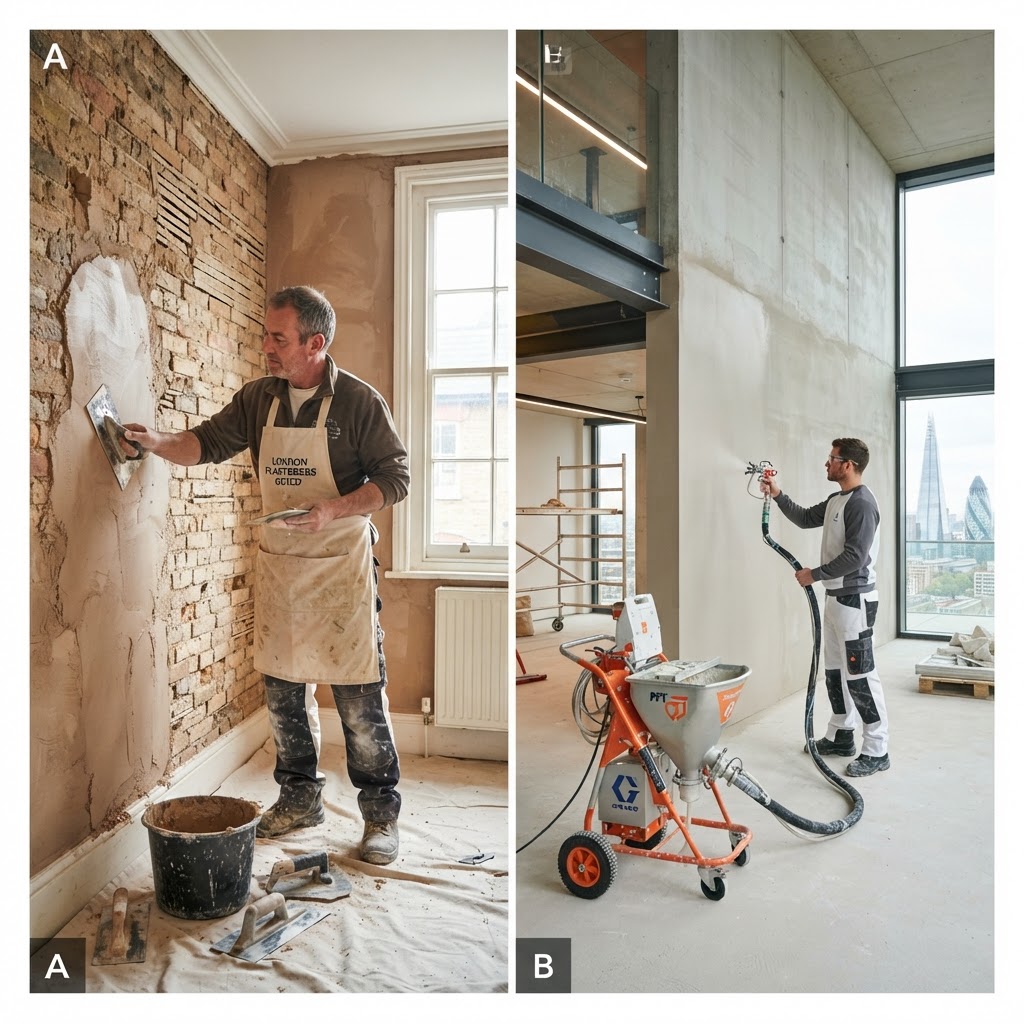
Spray Plastering vs Hand Plastering: A London Expert Guide
Introduction: The Evolution of Plastering in London
For decades, traditional hand plastering has been the gold standard for London homes, from the ornate Victorian terraces in Islington (N1) to the sleek, modern apartments surrounding Canary Wharf (E14). The London property market, known for its unique blend of heritage architecture and aggressive new-build expansion, demands versatility. However, the introduction of high-pressure machine spray plastering has fundamentally altered the landscape for developers, contractors, and homeowners. Whether you are searching for a plasterer-london or evaluating the efficiency of automated systems, understanding the technical nuances between these two methods is essential for ensuring project longevity and aesthetic perfection.
What is Traditional Hand Plastering?
Hand plastering is the age-old craft of applying wet plaster to internal walls and ceilings using a steel trowel and hawk. This process, often referred to as 'skimming' or 'floating and setting,' requires decades of experience to master. It is not merely a task of covering a surface but an art form that involves managing the suction of the substrate, the humidity levels of the room, and the specific setting time of the gypsum.
The Art of Heritage Preservation
In historic boroughs like Kensington and Chelsea (SW3, SW7), hand plastering is often non-negotiable. Many of these properties feature curved walls, intricate cornicing, and non-standard ceiling heights that modern spray machines simply cannot navigate. Hand-applied plaster allows for the meticulous restoration of period details, ensuring that the structural integrity of lath-and-plaster walls is maintained without the over-application of heavy materials.
Pros of Hand Plastering
- Superior Detail: Perfect for irregular surfaces, coving, and heritage repairs.
- Adaptability: Ideal for small spaces where large machinery cannot physically fit or be maneuvered.
- Craftsmanship: Allows for custom textures and seamless finishes in complex corners or bulkhead details.
- No Setup footprint: Zero requirement for 3-phase power or heavy-duty pump storage.
Cons of Hand Plastering
- Speed: Significantly slower; a single room may take a full day to prep and skim.
- Labor Costs: High labor intensity drives up the Plastering Cost London rates, especially given the skilled worker shortage.
- Consistency: Subject to human fatigue over massive floor plates, which can lead to slight undulations in the surface.
The Rise of Spray Plastering: Industrial Efficiency
Spray plastering utilizes a heavy-duty pump machine to project atomized plaster onto the substrate, which is then leveled by hand with a large 'darby' or specialized spatula. This method is the engine room of the modern London residential development sector.
Why Developers Prefer Spray
When converting large warehouses in areas like Hackney (E8) or developing blocks in Stratford (E15), time is currency. Spray machines allow a two-person team to cover up to 300-400 square meters per day—a volume that would take a traditional team three or four times longer to achieve. The uniformity is achieved because the machine regulates the mix ratio precisely, eliminating the variation often found when mixing plaster by hand in buckets.
Pros of Spray Plastering
- Speed: 3-4 times faster than hand application.
- Finish: Produces a flat, consistent surface that is highly resistant to glancing light, which is crucial for modern downlighting.
- Efficiency: Significant reduction in material waste; the machine uses a precise pump rate to ensure minimal splatter.
Cons of Spray Plastering
- Setup Time: Requires significant space for machinery, specialized masking of windows and floors, and 110v/240v high-amperage power sources.
- Limited Use: Not suited for small, high-detail work like Emergency Plaster Repair London in tight, occupied residential spaces.
2026 London Market Pricing Analysis
London pricing is hyper-localized based on access, proximity to labor pools, and property age. In zones 1-2, prices are generally 15-20% higher than in the outer boroughs due to parking restrictions and ULEZ logistics.
- Hand Skimming: Expect to pay £220 to £300 per room for standard WallSkimmingLondon services. For high-end, multi-coat finishes on lime plaster, costs can rise to £450+ per room.
- Spray Plastering: For large FullHouseReplasterLondon projects (3+ bedrooms), spray application saves roughly 10-15% on labor hours. Expect typical costs between £3,500 and £6,000 for full-property skim coatings.
- Logistics Surcharges: Adding a £50-£100 'congestion/parking fee' is standard for contractors working in areas like Mayfair or the City of London where logistics are difficult.
Which Method Should You Choose?
- Renovating a Victorian Terrace (e.g., Islington/Hampstead): Opt for hand plastering. The necessity of matching existing, often uneven surfaces requires the 'feel' that only a human hand can provide.
- New Build Apartments (e.g., Greenwich Peninsula/Stratford): Spray plastering is superior. The uniformity makes it the only viable choice for achieving a high-quality finish across vast, open-plan developer schemes.
Frequently Asked Questions (FAQ)
Is spray plastering cheaper in London?
For projects exceeding 150 square meters, yes. The savings in man-hours usually outweigh the mobilization costs of the machine. However, for a single room, the setup time makes it exponentially more expensive than traditional manual methods.
Can spray plastering be used for patch repairs?
No. Patch repairs are surgical operations. A machine is a sledgehammer; a trowel is a scalpel. Using a spray system for a 1-meter patch would be like using a crane to hang a picture frame.
Does spray plastering dry faster?
Not chemically faster. However, because spray plaster is often applied in a single, perfectly measured layer, the moisture content is more uniform. This leads to a more predictable drying curve, often allowing decorators to begin priming 24-48 hours earlier than traditional methods.
Will I get a smoother finish with spray?
Spray plaster provides a flatter surface, which is ideal for flat, white-painted walls. However, 'smoothness' is a function of the plasterer's skill. A master plasterer can achieve a 'glass-like' finish manually that is indistinguishable from a sprayed wall.
Does spray plastering cause more mess than hand work?
Actually, no. While the machine setup takes more room, it is a 'contained' process. Hand plastering involves more 'flicking' and excess material falling to the floor. Spray systems are cleaner provided the masking (taping of floors/fixtures) is performed to a high standard.
Can I use spray plaster on external walls?
Most interior spray plasters are gypsum-based and hygroscopic. They cannot be used for external render. For external work, you would need a spray-render system, which is a entirely different class of machinery and material than the indoor skimming discussed here.
Final Recommendation
Whether you need the steady hand of a master craftsman for a restoration project or the high-output speed of modern spray technology for your new build, London Plastering Service offers the expertise required. Our team understands the nuances of the London housing market, from the narrow hallways of old Victorian stock to the expansive layouts of modern skyscraper apartments.
Need expert advice for your specific project? Contact London Plastering Service today for a professional site consultation and a tailored quotation that accounts for your borough’s unique logistics.
Related Plastering Guides & Services
Need Professional Plastering?
Get expert plastering services in London. Free quotes within 60 minutes.