
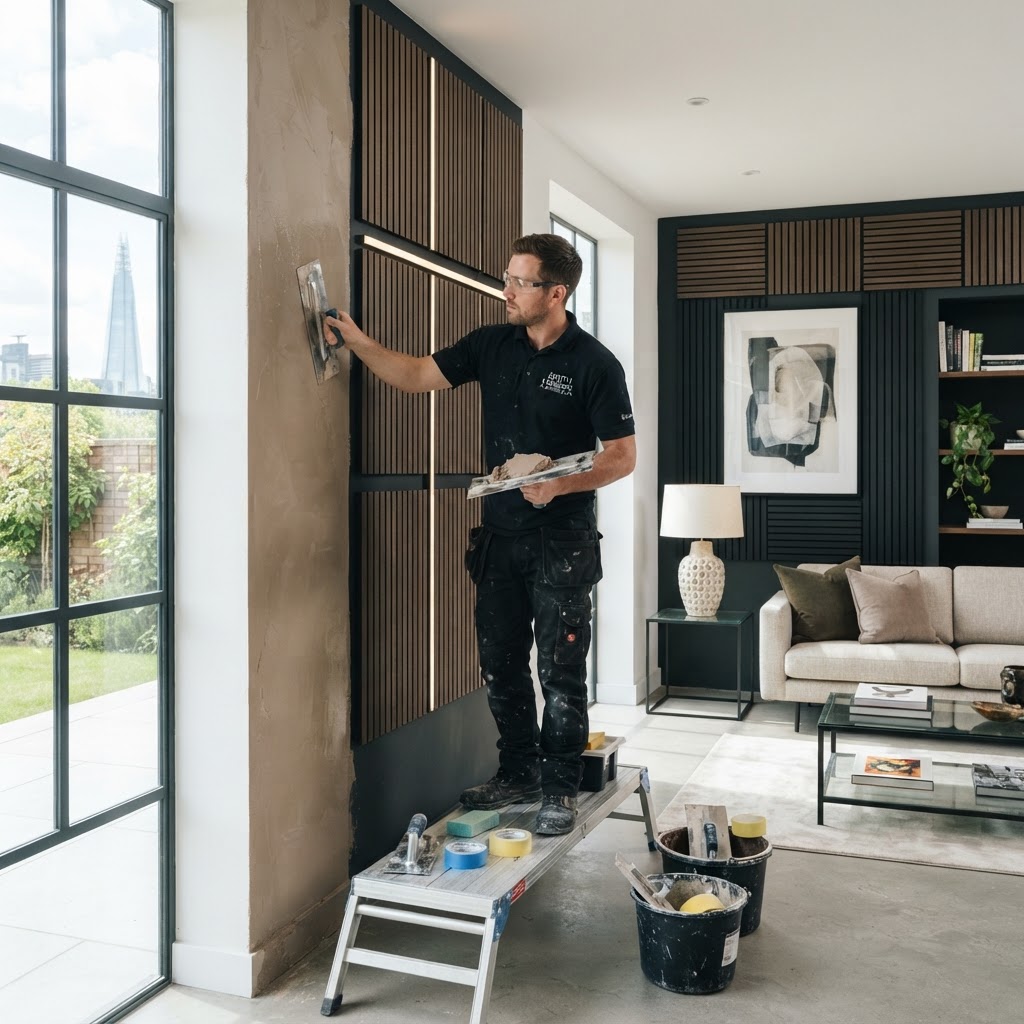
Acoustic Plastering Guide: Soundproofing Solutions for London Homes
Acoustic Plastering Guide: Soundproofing Solutions for London Homes
Living in a vibrant city like London comes with its challenges, and noise pollution is often at the top of the list. From the constant hum of traffic in Kensington to the lively street music in Camden, or the neighbourly symphony of a shared wall in a Brixton terrace, the urban soundscape can be overwhelming. Soundproofing your home is no longer a luxury but a necessity for maintaining a peaceful and productive living environment. As a professional plasterer London team with extensive experience across the capital's diverse boroughs, we understand the unique acoustic challenges Londoners face and offer tailored, modern solutions that dramatically improve quality of life.
What is Acoustic Plastering? A Deeper Dive
Acoustic plastering is a specialised form of plaster application designed specifically to manage sound transmission and reverberation within a space. Unlike standard plastering, which primarily focuses on creating a smooth, aesthetically pleasing surface, acoustic plastering employs materials with superior sound-absorbing and sound-insulating properties. These aren't just skim coats; they are engineered compounds that can significantly reduce the decibel levels entering or leaving a room.
Our process often involves a multi-layered approach. This typically begins with preparing the substrate – be it brick, block, or existing plasterboard – to ensure optimal adhesion. We then frequently install high-density acoustic mineral wool insulation within stud walls or ceiling cavities. This is followed by the application of specialised acoustic plasterboards, which are inherently denser and have better sound-dampening qualities than standard drywall. These boards are then finished with an acoustic plaster skim coat. This skim coat is not just a thin decorative layer; it's a crucial component of the system, designed to absorb sound waves and scatter them, thereby reducing echo and reverberation. The density of the acoustic plaster itself plays a vital role in blocking airborne sound, while the combination of insulation, dense boards, and specific plaster application tackles both airborne and impact noise transmission.
The Comprehensive Benefits of Soundproofing Your London Home
Beyond the immediate relief from intrusive noise, the advantages of investing in acoustic plastering extend far beyond mere silence:
- Enhanced Privacy and Focus: In an era where home offices are commonplace and personal space is highly valued, acoustic plastering is invaluable. Whether you're on a crucial video call in your Ealing home office or seeking undisturbed rest in your bedroom in Hampstead, a soundproofed room provides the sanctuary you need. This is particularly crucial in densely populated areas like Tower Hamlets, where apartments often share thin walls.
- Increased Property Value and Market Appeal: A property that offers a quiet retreat from the city's clamour is a significant selling point in the fiercely competitive London real estate market. Homes with documented soundproofing measures, especially in sought-after postcodes like SW1 (Westminster) or EC2 (City of London), command higher prices and attract discerning buyers.
- Improved Well-being and Reduced Stress: Constant exposure to noise pollution has been linked to increased stress levels, sleep disturbances, and even health problems. By investing in acoustic plastering, you are investing in your mental and physical well-being, creating a calmer, more restorative living environment within your home.
- Enhanced Thermal Efficiency: Many high-performance acoustic insulation materials and plasterboards also offer excellent thermal insulation properties. This means your home will retain heat more effectively during colder months, leading to reduced energy consumption and lower heating bills – a welcome benefit for London homeowners navigating rising energy costs. This dual benefit is particularly attractive for homeowners undertaking renovations in areas like Richmond, where energy efficiency is a growing concern.
- Aesthetic Integration: Modern acoustic plastering systems are designed to be seamlessly integrated into your home's existing aesthetics. Unlike bulky, old-fashioned soundproofing solutions, our methods are clean, unobtrusive, and can be finished to match your desired decor, often indistinguishable from standard plasterwork until you experience the profound difference in sound.
For walls that are structurally unsound, uneven, or exhibit signs of damage, we often recommend our expert Wall Skimming London services as a crucial preparatory step. A perfectly smooth and stable substrate ensures that the acoustic materials and plaster adhere optimally, maximizing their performance. For those grappling with persistent cracking in ceilings, particularly common in older London properties in areas like Fulham, our Ceiling Plaster Repair London service can be seamlessly integrated with sound-dampening mesh and acoustic compounds to not only repair the damage but also enhance sound isolation.
2026 London Acoustic Plastering Pricing Guide: Detailed Breakdown
Understanding the investment required for acoustic plastering is essential. Costs in the London market for 2026 can fluctuate based on project scope, material choices, the specific acoustic performance required (e.g., soundproofing a home cinema versus a bedroom), and the existing condition of the property. Here’s a more detailed breakdown:
- High-Density Acoustic Boarding Installation: This typically involves specialised, denser plasterboards designed for sound insulation. The cost for supply and professional installation ranges from £45 to £75 per square metre. This price often includes the boarding itself and the labour for fitting it securely, ensuring proper jointing and sealing, which is critical for acoustic performance.
- Acoustic Skim Coat Application: The finishing layer of acoustic plaster is denser and formulated differently from standard plaster. Applying this specialised skim coat over acoustic boards or prepared surfaces costs approximately £35 to £55 per square metre. This covers the material and the skilled labour required for a smooth, seamless finish that contributes significantly to sound absorption.
- Comprehensive Room Sound Insulation Package: For a complete room transformation, encompassing walls, potentially ceilings, and ensuring acoustic decoupling, prices can range significantly. For a standard-sized room (e.g., a bedroom in a flat in Zone 2 like Clapham), expect costs to be between £2,800 and £7,000. Larger projects, such as soundproofing a whole floor, a dedicated home cinema, or multiple separating walls in a terraced house in areas like Hampstead, could range from £8,000 to £20,000+, depending on the complexity, the number of treatments required (e.g., resilient channels, acoustic sealants, double-layer boarding), and the specific decibel reduction targets.
For a broader perspective on general plastering rates and to compare against standard services, you can refer to our comprehensive Plastering Prices London guide. It’s important to note that for extensive renovations or new builds, we often integrate acoustic plastering with our Dry Lining London services. Dry lining, when combined with acoustic treatments and resilient channels, provides excellent acoustic decoupling, effectively isolating rooms from structural vibrations and impact noise, which is particularly beneficial in apartment buildings across Westminster or new developments in Greenwich.
Choosing the Right Acoustic Solution for Your Specific London Property
London's rich architectural tapestry presents unique challenges and opportunities for soundproofing. Our approach is always bespoke, taking into account the building's age, construction type, and your specific noise concerns:
- Period Properties (e.g., Kensington, Hampstead, Islington): Older homes, often built with solid walls and suspended timber floors, can be prone to both airborne and impact noise. For these properties, we might recommend a combination of internal solid wall insulation using acoustic plaster applied directly or over specialised acoustic underlay, and for floors, a "floating floor" system or acoustic underlay beneath new floor coverings. We might also incorporate treatments for party walls, a common issue in Victorian terraces.
- Edwardian and Victorian Terraces (e.g., Clapham, Earl's Court): These homes often share party walls, making neighbourly noise a significant concern. Solutions here can involve adding mass and decoupling to the existing walls. This could mean installing sound-insulating boards like SoundBlock or Siniat GTEC, followed by an acoustic skim coat, or in more severe cases, constructing a secondary inner leaf wall with acoustic insulation. Repairing old fireplaces or chimneys, which can act as sound flues, is also a critical consideration.
- 1930s Semi-Detached and Detached Homes: These might have cavity walls which, if uninsulated, can transmit sound easily. We can assess whether cavity wall insulation is suitable and acoustically beneficial, or focus on internal treatments for walls and floors.
- Post-War and 1960s/70s Builds: These properties can vary in construction. Some may have concrete floors which are good for impact noise, but walls might still need treatment. Others might have timber frame construction requiring careful acoustic detailing.
- New Builds and Modern Apartments (e.g., Canary Wharf, Nine Elms): While often built to modern standards, sound transmission between apartments can still be an issue due to thin walls, floors, and service penetrations. Here, high-performance acoustic plasterboards and resilient channel systems are often employed to decouple the finishes from the structure, significantly reducing airborne and impact noise. Attention to acoustic seals around doors, windows, and service risers is paramount.
For properties with existing textured finishes like Artex, rather than removing it entirely, we can sometimes incorporate it into the acoustic solution. Our Artex Covering London service can be adapted; we ensure the Artex is sound and stable, then apply a bonding agent before installing acoustic boards or specialised acoustic plaster, effectively upgrading the surface's acoustic performance while preserving its character.
Expert Insights: Deeper Understanding of Acoustic Principles
Sound travels through a building in two primary ways: airborne sound and impact sound.
- Airborne Sound: This is sound that travels through the air, such as voices, music, or television. It can pass through small gaps, cracks, or directly through building materials. The key to combating airborne sound is mass and absorption. Denser, heavier materials (like acoustic plaster and specialised plasterboards) block sound transmission. Absorption materials (like mineral wool insulation) dissipate sound energy within cavities.
- Impact Sound: This is sound generated by physical contact, such as footsteps, dropped objects, or doors slamming. It travels through the building's structure. The most effective way to combat impact sound is decoupling – creating a break in the structure so the vibration cannot travel easily. This is achieved using systems like resilient channels (metal strips that hold plasterboard away from the joists or studs), acoustic clips, or floating floors. Simply adding mass won't solve impact noise effectively; decoupling is essential.
Flanking Noise: This is a more complex issue where sound travels indirectly through flanking elements – other parts of the building structure not directly involved in the transmission path (e.g., sound travelling through a floor, up a wall, and into the adjacent room via the ceiling joists). Addressing flanking noise often requires a more comprehensive strategy, treating multiple surfaces (walls, floors, and ceilings) and ensuring all penetrations are sealed.
Our expertise lies in diagnosing the specific sound transmission paths in your London property and designing a multi-faceted solution that addresses airborne, impact, and flanking noise effectively, using the right combination of mass, absorption, and decoupling.
Frequently Asked Questions (FAQ) - Expanded Answers
How much does it cost to soundproof a single wall in London?
For a standard internal wall in a London property, soundproofing typically involves adding mass and absorption. This could mean installing a layer of acoustic plasterboard (e.g., SoundBlock) directly onto the existing wall (if flat) or, more effectively, constructing a new stud frame with mineral wool insulation and then attaching acoustic plasterboard. The final layer would be a skim coat. The cost for this comprehensive treatment, including materials and professional labour, generally falls between £100 and £180 per square metre. This price can increase if the wall is particularly large, requires significant preparation, or if very high levels of sound reduction are needed, necessitating specialised acoustic sealants and multiple layers of plasterboard. Our Plastering Cost London page offers more granular details.
Is acoustic plastering the same as standard plastering or just a thicker skim coat?
Absolutely not. While both involve applying plaster, acoustic plastering is a fundamentally different process. Standard plastering primarily focuses on creating a smooth, durable, and aesthetically pleasing surface for decoration. It has minimal sound-dampening qualities. Acoustic plaster, on the other hand, is a high-performance material engineered with specific densities and compositions (often mineral-based) to actively absorb and reflect sound waves, reducing reverberation and blocking airborne noise. It's often used in conjunction with acoustic insulation boards and specialised installation techniques. Applying a thicker coat of standard plaster will not yield the acoustic benefits of true acoustic plastering.
How long does the soundproofing process typically take for a room?
The timeline for soundproofing a room, such as a standard bedroom (approximately 12-15 sqm floor area), usually spans 4 to 7 working days. This duration accounts for several stages: initial site assessment and preparation, installation of insulation and acoustic boards (which may involve building new stud frames or applying resilient channels), the application of the acoustic skim coat, and crucially, adequate drying time between layers. Drying times are longer for acoustic plasters than standard ones, especially in London's typically humid climate. Factors like the complexity of the room, the number of surfaces being treated (walls, ceiling, floor), and the specific acoustic system chosen can influence the total duration. We always factor in a buffer for optimal curing and drying to ensure the best long-term performance.
Will acoustic plastering eliminate all external noise from my London home?
While acoustic plastering significantly dampens and reduces noise transmission, it's unlikely to eliminate all external noise completely, especially in a busy urban environment like London. Our systems are highly effective at reducing airborne noise (like traffic, voices, loud music) and impact noise (like footsteps from above). However, extreme levels of noise or specific types of structural noise might still penetrate. Flanking noise, as mentioned earlier, can travel through unconventional routes in the building's structure, and addressing this might require a more comprehensive approach involving multiple rooms or structural interventions. Furthermore, very high-frequency sounds or extremely low-frequency vibrations can be challenging to block entirely without very specialised and often costly solutions. For most residential applications, however, acoustic plastering provides a dramatic and life-changing reduction in noise, creating a much more peaceful living space. It's about achieving a significant improvement, not necessarily absolute silence, though we strive for the quietest result possible for your budget and needs.
Can acoustic plastering help with echo within a room?
Yes, absolutely. One of the primary functions of acoustic plaster is to reduce reverberation and echo within a room. Unlike hard, reflective surfaces (like standard plaster, glass, or bare walls) that bounce sound waves around, causing echo and making a room sound 'live' or 'boomy', acoustic plaster is designed to absorb sound energy. This absorption process breaks up the sound waves, preventing them from bouncing repeatedly. The result is a clearer, more natural sound environment, which is highly beneficial for listening to music, watching films, holding conversations, or simply enjoying a quieter, more comfortable atmosphere. This is particularly noticeable in larger rooms or spaces with high ceilings in areas like Richmond or Hampstead.
What is the difference between acoustic plaster and soundproofing paint?
Soundproofing paint is often marketed as a DIY solution, but its effectiveness is generally very limited compared to true acoustic plastering. Soundproofing paint typically contains small amounts of ceramic or rubber particles designed to slightly dampen vibrations. However, its sound-blocking capabilities are minimal, offering perhaps a decibel or two reduction at best, and primarily targeting minor reverberation issues. Acoustic plaster, on the other hand, is a significantly thicker, denser material applied professionally. It works on the principles of mass, absorption, and diffusion, providing a substantial reduction in airborne and impact noise transmission. Comparing acoustic plaster to soundproofing paint is like comparing a solid soundproof wall to a coat of specialised paint – the difference in performance is immense.
Ready to Reclaim Your Peace and Quiet?
Don't let the relentless noise of London disrupt your life any longer. Whether you're envisioning a tranquil home office, a restful bedroom, or a peaceful living space free from neighbourly disturbances, our expert acoustic plastering services are the solution. From a complete Full House Replaster London project incorporating soundproofing throughout, to urgent Emergency Plaster Repair London to seal noise-leaking cracks, our team is dedicated to transforming your home into a sanctuary of calm. Contact us today for a detailed consultation, a transparent quote, and to start your journey towards a quieter, more comfortable London lifestyle.
Related Plastering Guides & Services
Need Professional Plastering?
Get expert plastering services in London. Free quotes within 60 minutes.